February 8, 2010

RFK, Jr. 15 months ago: Global warming means no snow or cold in DC

By: David Freddoso
Online Opinion Editor

Robert F. Kennedy Jr., who flies around on private planes so as to tell larger numbers of people how they must live their lives in order to save the planet, wrote a column last year on the lack of winter weather in Washington, D.C.

In Virginia, the weather also has changed dramatically. Recently arrived residents in the northern suburbs, accustomed to today’s anemic winters, might find it astonishing to learn that there were once ski runs on Ballantrae Hill in McLean, with a rope tow and local ski club. Snow is so scarce today that most Virginia children probably don’t own a sled. But neighbors came to our home at Hickory Hill nearly every winter weekend to ride saucers and Flexible Flyers.

In those days, I recall my uncle, President Kennedy, standing erect as he rode a toboggan in his top coat, never faltering until he slid into the boxwood at the bottom of the hill. Once, my father, Atty. Gen. Robert Kennedy, brought a delegation of visiting Eskimos home from the Justice Department for lunch at our house. They spent the afternoon building a great igloo in the deep snow in our backyard. My brothers and sisters played in the structure for several weeks before it began to melt. On weekend afternoons, we commonly joined hundreds of Georgetown residents for ice skating on Washington’s C&O Canal, which these days rarely freezes enough to safely skate.

Meanwhile, Exxon Mobil and its carbon cronies continue to pour money into think tanks whose purpose is to deceive the American public into believing that global warming is a fantasy.

Having shoveled my walk five times in the midst of this past weekend’s extreme cold and blizzard, I think perhaps RFK, Jr. should leave weather analysis to the meteorologists instead of trying to attribute every global phenomenon to anthropogenic climate change.

Beltway Confidential

_______________________________

Megaera says:

“Am I the only one who finds RFKjr’s charming memories of snowfalls lasting weeks and weekly sledding throughout winter in an area which is in fact a part of the South and was considered a fever swamp just slightly bizarre? (No, I agree with you 100%) DC has NEVER had winters the like of which he’s describing. He was 6 when JFK and RFK went to DC, 9 when JFK died and the family went back to Massachusetts (Lyndon wasted no time getting shut of Bobby), and I will politely assume that his memories are muddled, not that he’s outright lying. Though of course he may well be. He’s a politician with an agenda, and that trumps everything.”

I couldn’t have said it better myself. The Kennedys have become the laughing stock of the country and will be remembered as a family reviled by their own generation who are disgusted with their lies, betrayal of the Dem Presidential candidate, Hillary Clinton and their ‘do nothing’ for America but enrich themselves agenda.

Vilified ‘Climategate’ Scientist Says He Considered Suicide

Phil Jones, the British scientist at the center of a worldwide scandal over e-mails appearing to show climate scientists manipulating global warming data, says he considered killing himself “several times” during the crisis, the Times of London reports.

“I am just a scientist,” Jones said. “I have no training in PR or dealing with crises.” As climate change deniers called for him to resign his post, and even making threats on his life, Jones lost weight and went on beta-blockers and sleeping pills. He continues to receive death threats, including two in the past week. “I was shocked,” he said. “People said I should go and kill myself. They said that they knew where I lived. They were coming from all over the world.”

In e-mails that global warming deniers seized on ahead of the Copenhagen climate summit late last year, Jones appeared to call on his colleagues to destroy evidence that would counter proof of climate change. Jones has vehemently stood by his work, saying that the e-mails written by him and other scientists were deliberately taken out of context and misconstrued to create the appearance of scandal. Several informal reviews have agreed that no scientific misconduct took place, and the incident is being reviewed by the U.N. climate change panel.
___________________________

Suicide is never an option for a person innocent of allegations of lying .. They stay and fight until their last breath… they don’t take the easy way out with and overdose of sleeping pills or jumping out of 10 story windows


U.N. Climate Panel Apologizes for Faulty 2007 Statement on Melting Glaciers

The Intergovernmental Panel on Climate Change, the division of the United Nations that researches global warming, apologized Wednesday for a 2007 report that claimed the Himalayan glaciers would melt by 2035, CNN reports.

The IPCC was responding a controversy swirling around a particular paragraph in the 2007 statement that had come from a long chain of popular articles — essentially scientific hearsay. The statement read: “Glaciers in the Himalaya are receding faster than in any other part of the world, and if the present rate continues, the likelihood of them disappearing by the year 2035 and perhaps sooner is very high if the Earth keeps warming at the current rate. Its total area will likely shrink from the present 500,000 to 100,000 square kilometers by the year 2035.”

The paragraph was based on information from a 2005 report by the World Wildlife Fund, which had in turn been taken from an article that appeared in the popular UK science journal, The New Scientist in June 1999. The data in the original article was later deemed faulty, and the IPCC called its own statement “poorly substantiated,” admitting that “well-established standards of evidence were not applied properly.”
As the wheels come off this presidency and his cap and trade scam is revealed more Americans are catching on they’ve been scammed

(please read the comments at link)

February 3, 2010

Obama Retreats From Goal of Cap-Trade Bill

….no surprise there- seeing the Global Warming hoax has been exposed for what it is… (see below main article)

NASHUA, N.H.—President Barack Obama said for the first time Tuesday that legislation that would require industries to pay for emissions of greenhouse gases may need to be separated from a more popular “green jobs” bill in the Senate, a maneuver that could kill what once had been one of the administration’s top policy priorities.

…. Another Obama policy failure! In this case a failure in the public’s favor.

Answering a participant in a town-hall meeting in Nashua who asked about green jobs—those connected to renewable energy—and so-called cap-and-trade legislation, Mr. Obama said, “The only thing I would say about it is this: We may be able to separate these things out. And it’s possible that that’s where the Senate ends up.”

Until now, the Obama administration has refused to entertain in public the idea that lawmakers might have to split up the climate bill. The shift by the president is another sign that the White House is rethinking strategy on big first-year agenda items such as health care and climate legislation, after public dissatisfaction with its focus on those issues helped cost Democrats their filibuster-proof hold on the Senate last month.

The idea behind the cap-and-trade aspect of the climate bill is to create a market in permits that confer the right to emit greenhouse gases, which are believed to contribute to global warming. Businesses would be required to hold these permits, and over time the government would curtail the supply of permits to reduce the total amount of gases produced.

This is the nexus of the scam…. generate money for Fat Cats buying Carbon Credits at auction for re-sale later on to business’ needing the credits to be in compliance with Fed Regs. (Of course, the plan all along was passing the cost of carbon credits back to the consumer.)

Now that the Climatology hoax: “humans are responsible for CO2 pollution has been exposed as an outright LIE.” IT will no longer be a threat to the liberty and pocketbooks of citizens. Score one for citizens.

A White House spokesman downplayed the president’s comments, saying Mr. Obama still favored a bill that would combine measures to encourage jobs in green-energy fields with the establishment of a trading mechanism for emissions.

Isolating the cap-and-trade proposal would make it easier for Democrats who oppose putting a price on greenhouse-gas emissions to set that part of the climate bill aside, and vote for the more popular jobs incentives now contained in the wide-ranging measure.

Mr. Obama pushed in his State of the Union speech last week for “a comprehensive energy and climate bill with incentives that will finally make clean energy the profitable kind of energy in America.”

The climate bill in the Senate is opposed by legislators from both parties whose local economies rely on fossil fuels, and smokestack industries like steel mills and coal-fired utilities. These lawmakers worry a cap-and-trade system will burden these industries with new costs.

Mr. Obama’s comments on Tuesday came amid new signs of resistance by some fellow Democrats to his administration’s efforts to combat climate change.

On Tuesday, two senior House Democrats—Reps. Ike Skelton of Missouri, chairman of the House Armed Services Committee, and Collin Peterson of Minnesota, chairman of the House Agriculture Committee—introduced legislation to prohibit the Environmental Protection Agency from regulating greenhouse-gas emissions under the Clean Air Act. In a written statement, Mr. Skelton called for setting aside legislation already passed by the House to cap greenhouse-gas emissions, and instead passing “scaled-back energy legislation” that could command greater support in both parties.

“We cannot tolerate turning over the regulation of greenhouse-gas emissions to unelected bureaucrats at EPA,” Mr. Skelton said.

One possibility for Senate Democrats is to push forward with a bill already approved by the Senate Committee on Energy and Natural Resources that would require electric utilities nationwide to generate 15% of their electricity supplies through renewable resources, with some portion met by energy efficiency measures, by 2021. The bill would also open the Eastern Gulf of Mexico to leasing and exploration for oil and gas, and establish energy efficiency standard for table and floor lamps. WSJ Link


The Hottest Hoax in the World

It was presented as fact. The UN’s Intergovernmental Panel on Climate Change, led by India’s very own RK Pachauri, even announced a consensus on it. The world was heating up and humans were to blame. A pack of lies, it turns out.

The climate change fraud that is now unravelling is unprecedented in its deceit, unmatched in scope—and for the liberal elite, akin to 9 on the Richter scale. Never have so few fooled so many for so long, ever.

The entire world was being asked to change the way it lives on the basis of pure hyperbole. Propriety, probity and transparency were routinely sacrificed.

The truth is: the world is not heating up in any significant way. Neither are the Himalayan glaciers going to melt as claimed by 2035. Nor is there any link at all between natural disasters such as Hurricane Katrina and global warming. All that was pure nonsense, or if you like, ‘no-science’!

The climate change mafia, led by Dr Rajendra K Pachauri, chairperson of the Intergovernmental Panel on Climate Change (IPCC), almost pulled off the heist of the century through fraudulent data and suppression of procedure. All the while, they were cornering millions of dollars in research grants that heaped one convenient untruth upon another. And as if the money wasn’t enough, the Nobel Committee decided they should have the coveted Peace Prize.

But let’s begin at the beginning. Mr Pachauri has no training whatsoever in climate science. This was known all the time, yet he heads the pontification panel which proliferates the new gospel of a hotter world. How come? Why did the United Nations not choose someone who was competent? After all, this man is presumably incapable of differentiating between ocean sediments and coral terrestrial deposits, nor can he go about analysing tree ring records and so on. That’s not jargon; these are essential elements of a syllabus in any basic course on climatology.

You cannot blame him. His degree and training is in railroad engineering. You read it right. This man was educated to make railroads from point A to point B.

THE GATHERING STORM

There are many casualties in this sad story of greed and hubris. The big victim is the scientific method. This was pointed out in great detail by John P Costella of the Virginia-based Science and Public Policy Institute. Science is based on three fundamental pillars. The first is fallibility. The fact that you can be wrong, and if so proven by experimental input, any hypothesis can be—indeed, must be—corrected.

This was systematically stymied as early as 2004 by the scientific in-charge of the University of East Anglia’s Climate Change Unit. This university was at the epicentre of the ‘research’ on global warming. It is here that Professor Phil Jones kept inconvenient details that contradicted climate change claims out of reports.

The second pillar of science is that by its very nature, science is impersonal. There is no ‘us’, there is no ‘them’. There is only the quest. However, in the entire murky non-scientific global warming episode, if anyone was a sceptic he was labelled as one of ‘them’. At the very apex, before his humiliating retraction, Pachauri had dismissed a report by Indian scientists on glaciers as “voodoo science”.

The third pillar of science is peer group assessment. This allows for validation of your thesis by fellow scientists and is usually done in confidence. However, the entire process was set aside by the IPCC while preparing the report. Thus, it has zero scientific value.

The fact that there was dissent within the climate science teams, that some people objected to the very basis of the grand claims of global warming, did not come out through the due process. It came to light when emails at the Climate Research Centre at East Anglia were hacked in November 2009. It is from the hacked conversations that a pattern of conspiracy and deceit emerge. It is a peek into the world of global warming scaremongering—amplify the impact of CO2, stick to dramatic timelines on destruction of forests, and never ask for a referral or raise a contrary point. You were either a believer in a hotter world or not welcome in this ‘scientific fold’.

HOUSE OF CARDS AND COLOUR OF CASH

So we have the fact that a non-expert heads the IPCC. We have the fact that glaciers are not melting by 2035; this major scaremongering is now being defended as a minor error (it was originally meant to be 2350, some have clarified). The date was spouted first by Syed Hasnain, an Indian glacier expert, in an interview to a magazine. It had no scientific validity, and, as Hasnain has himself said, was speculative.

On the basis of that assertion, The Energy and Resources Institute (Teri) that Pachauri heads and where Hasnain works in the glaciology team, got two massive chunks of funding. The first was estimated to be a $300,000 grant from Carnegie Corporation and the second was a part of the $2 million funding from the European Union. So you write a report that is false on glaciers melting and get millions to study the impact of a meltdown which will not be happening in the first place. Now if this is not a neat one, what is?

The same goes for dire predictions on Amazon rain forests. The IPCC maintained that there would be a huge depletion in Amazon rain forests because of lack of precipitation. Needless to add, no Amazon rain forest expert could be trusted to back this claim. They depended on a report by a freelance journalist and activist, instead, and now it has blown up in their faces.

There’s plenty more in this sordid tale. For one thing, there is no scientific consensus at all that man-made CO2 emissions cause global warming, as claimed by the IPCC. In a recent paper, Lord Monckton of Brenchley, who has worked extensively on climate change models, argues: ‘There is no scientific consensus on how much the world has warmed or will warm; how much of the warming is natural; how much impact greenhouse gases have had or will have on temperature; how sea level, storms, droughts, floods, flora, and fauna will respond to warmer temperature; what mitigative steps—if any—we should take; whether (if at all) such steps would have sufficient (or any) climatic effect; or even whether we should take any steps at all.’

An investigation by Dr Benny Peiser, director, Global Warming Policy Foundation, has revealed that only 13 of the 1,117, or a mere 1 per cent of the scientific papers crosschecked by him, explicitly endorse the consensus as defined by the IPCC. Thus the very basis of the claim of consensus on global warming is false. And so deeply entrenched is the global warming lobby, the prestigious journal Science did not publish a letter that Dr Peiser wrote pointing out the lack of consensus.

Speaking to Open, says Dr Peiser, “The IPCC process by which it arrives at its conclusions lacks balance, transparency and due diligence. It is controlled by a tightly knit group of individuals who are completely convinced that they are right. As a result, conflicting data and evidence, even if published in peer-reviewed journals, are regularly ignored, while exaggerated claims, even if contentious or not peer-reviewed, are often highlighted in IPCC reports. Not surprisingly, the IPCC has lost a lot of credibility in recent years. It is also losing the trust of more and more governments who are no longer following its advice. Until it agrees to undergo a root and branch reform, it will continue to haemorrhage credibility and trust. The time has come for a complete overhaul of its structure and workings.”

Another fraud is in the very chart central to Pachauri’s speech at the Copenhagen summit. As Lord Monckton has pointed out, ‘The graph is bogus not only because it relies on made-up data from the Climate Research Unit at the University of East Anglia, but also because it is overlain by four separate trendlines, each with a start-date carefully selected to give the entirely false impression that the rate of warming over the past 150 years has itself been accelerating, especially between 1975 and 1998. The truth, however—neatly obscured by an ingenious rescaling of the graph and the superimposition of the four bogus trend lines on it—is that from 1860 to 1880 and again from 1910 to 1940 the warming rate was exactly the same as the warming rate from 1975 to 1998.’

Pachauri’s Wrong Numbers:

This chart, tracking mean global temperature over the past 150 years, was central to the presentation that IPCC Chairman Rajendra K. Pachauri made at the Copenhagen environment summit. Many scientists believe that the graph is fraudulent. First, there are strong allegations that the data, collected from the Climate Research Unit at the University of East Anglia, is a tissue of lies. Plus, as British climate change expert Lord Christopher Monckton puts it: “(The main graph, in darker blue) is overlain by four separate lines, each carefully selected to give the entirely false im•pression that the rate of warming over the past 150 years has itself been accelerating, especially between 1975 and 1998. The truth, however... is that from 1860 to 1880 and again from 1910 to 1940, the warming rate was exactly the same as the warming rate from 1975 to 1998.” In other words, the graph has been drawn with a motive to prove one’s point, and not to show the truth.

Read much more relating to this article here at link

December 28, 2009

No statistically significant warming since 1995: a quick mathematical proof

Physicist Luboš Motl of The Reference Frame demonstrates how easy it is to show that there is: No statistically significant warming since 1995

Because there has been some confusion – and maybe deliberate confusion – among some (alarmist) commenter’s about the non-existence of a statistically significant warming trend since 1995, i.e. in the last fifteen years, let me dedicate a full article to this issue.</p> <p>I will use the UAH temperatures whose final 2009 figures are de facto known by now (with a sufficient accuracy) because UAH publishes the daily temperatures, too.


Mathematics can calculate the confidence intervals for the slope (warming trend) by concise commands. But I will calculate the standard error of the slope manually.

(To view actual mathmatical calculations go to main link at the bottom of post)

The UAH 1995-2009 slope was calculated to be 0.95 °C per century. And the standard deviation of this figure, calculated via the standard formula on this page, is 0.88 °C/century. So this suggests that the positivity of the slope is just a 1-sigma result – a noise. Can we be more rigorous about it? You bet.

Mathematica actually has compact functions that can tell you the confidence intervals for the slope.

The 99% confidence intervalis (-1.59, +3.49) in °C/century. Similarly, the 95% confidence interval for the slope is (-0.87, 2.8) in °C/century. On the other hand, the 90% confidence interval is (-0.54, 2.44) in °C/century. All these intervals contain both negative and positive numbers. No conclusion about the slope can be made on either 99%, 95%, and not even 90% confidence level.

Only the 72% confidence interval for

We can only say that it is “somewhat more likely than not” that the underlying trend in 1995-2009 was a warming trend rather than a cooling trend. Saying that the warming since 1995 was “very likely” is already way too ambitious a goal that the data doesn’t support.

LINK


RUSSIA MAY BE THE NEW HOME OF NORTH POLE

North Magnetic Pole Moving East Due to Core Flux


Richard A. Lovett in San Francisco
for National Geographic News
December 24, 2009

Earth’s north magnetic pole is racing toward Russia at almost 40 miles (64 kilometers) a year due to magnetic changes in the planet’s core, new research says.

The core is too deep for scientists to directly detect its magnetic field. But researchers can infer the field’s movements by tracking how Earth’s magnetic field has been changing at the surface and in space.

Now, newly analyzed data suggest that there’s a region of rapidly changing magnetism on the core’s surface, possibly being created by a mysterious “plume” of magnetism arising from deeper in the core.

And it’s this region that could be pulling the magnetic pole away from its long-time location in northern Canada, said Arnaud Chulliat, a geophysicist at the Institut de Physique du Globe de Paris in France.

Finding North

Magnetic north, which is the place where compass needles actually point, is near but not exactly in the same place as the geographic North Pole. Right now, magnetic north is close to Canada’s Ellesmere Island.

Navigators have used magnetic north for centuries to orient themselves when they’re far from recognizable landmarks.

Although global positioning systems have largely replaced such traditional techniques, many people still find compasses useful for getting around underwater and underground where GPS satellites can’t communicate.

The magnetic north pole had moved little from the time scientists first located it in 1831. Then in 1904, the pole began shifting northeastward at a steady pace of about 9 miles (15 kilometers) a year.

In 1989 it sped up again, and in 2007 scientists confirmed that the pole is now galloping toward Siberia at 34 to 37 miles (55 to 60 kilometers) a year.

A rapidly shifting magnetic pole means that magnetic-field maps need to be updated more often to allow compass users to make the crucial adjustment from magnetic north to true North.

Wandering Pole

Geologists think Earth has a magnetic field because the core is made up of a solid iron center surrounded by rapidly spinning liquid rock. This creates a “dynamo” that drives our magnetic field.
Scientists had long suspected that, since the molten core is constantly moving, changes in its magnetism might be affecting the surface location of magnetic north.
Although the new research seems to back up this idea, Chulliat is not ready to say whether magnetic north will eventually cross into Russia.
“It’s too difficult to forecast,” Chulliat said.

Also, nobody knows when another change in the core might pop up elsewhere, sending magnetic north wandering in a new direction.

Chulliat presented his work this week at a meeting of the American Geophysical Union in San Francisco. LINK

December 24, 2009

GLAD TIDINGS TO YOU ~ WISHING YOU ALL THE JOY OF THE SEASON…

Three Angels by Chagal

“THREE ANGELS” by Bob Dylan

When you have an extra minute, please spend it reading here:

Click on the "BRO" for President Grinch

December 23, 2009

Climate change alliance crumbling

Cracks emerged on Tuesday in the alliance on climate change formed at the Copenhagen conference last week, with leading developing countries criticising the resulting accord.

But on Tuesday the Brazilian government labeled the accord “disappointing” and complained that the financial assistance it contained from rich to poor countries was insufficient.

South Africa also raised objections: Buyelwa Sonjica, the environment minister, called the failure to produce a legally binding agreement “unacceptable”. She said her government had considered leaving the meeting.

“We are not defending this, as I have indicated, for us it is not acceptable, it is definitely not acceptable,” she said.

There was even harsher criticism from Andreas Carlgren, environment minister of Sweden, current holder of the rotating European Union presidency, who proclaimed the Copenhagen accord “a disaster” and “a great failure”.

These responses contrasted with praise of the accord from India and China, and may presage problems for the United Nations in keeping the fragile alliances formed in Copenhagen together. The UN wants to sign a legally binding treaty by the end of 2010, but will struggle if countries repudiate the accord.

However, Todd Stern, US special envoy for climate change, noted that more than 100 countries had backed the accord, including the EU, Australia, Japan, the African Union and the Alliance of Small Island States.

China hit back at claims from the UK and other developed countries that it vetoed two key targets in the accord, and thus scuttled a more ambitious deal. Jiang Yu, a foreign ministry spokeswoman, called criticism from Ed Miliband, the UK’s climate secretary, “plainly a political scheme” to provoke disagreement among developing countries.

The accord focused on three key issues: greenhouse gas emissions cuts from developed and developing countries; a global target on limiting temperature rises; and financial help from rich to poor countries.

India applauded the outcome. Jairam Ramesh, environment minister, told India’s parliament on Tuesday: “The Basic group has emerged as a powerful force in climate change negotiations.”

  • In spite of welcoming the accord, Mr Ramesh conceded that it was only a “very, very small step forward”.
  • Link

    December 21, 2009

    There’ll be nowhere to run from the New World Government..

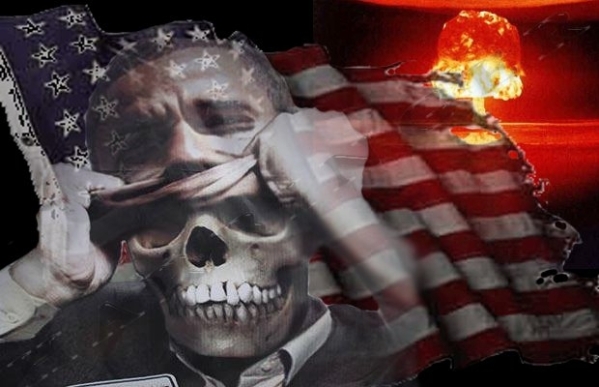
    Obama Saluting America!

    There is scope for debate – and innumerable newspaper quizzes – about who was the most influential public figure of the year, or which the most significant event. But there can be little doubt which word won the prize for most important adjective. 2009 was the year in which “global” swept the rest of the political lexicon into obscurity. There were “global crises” and “global challenges”, the only possible resolution to which lay in “global solutions” necessitating “global agreements”. Gordon Brown actually suggested something called a “global alliance” in response to climate change. (Would this be an alliance against the Axis of Extra-Terrestrials?)

    The committee to save the world: Barack Obama, Nicolas Sarkozy, Angela Merkel, Gordon Brown and other leaders at the Copenhagen climate talks Photo: AFP/GETTY

    Some of this was sheer hokum: when uttered by Gordon Brown, the word “global”, as in “global economic crisis”, meant: “It’s not my fault”. To the extent that the word had intelligible meaning, it also had political ramifications that were scarcely examined by those who bandied it about with such ponderous self-importance. The mere utterance of it was assumed to sweep away any consideration of what was once assumed to be the most basic principle of modern democracy: that elected national governments are responsible to their own people – that the right to govern derives from the consent of the electorate.

    The dangerous idea that the democratic accountability of national governments should simply be dispensed with in favour of “global agreements” reached after closed negotiations between world leaders never, so far as I recall, entered into the arena of public discussion. Except in the United States, where it became a very contentious talking point, the US still holding firmly to the 18th-century idea that power should lie with the will of the people.

    Nor was much consideration given to the logical conclusion of all this grandiose talk of global consensus as unquestionably desirable: if there was no popular choice about approving supranational “legally binding agreements”, what would happen to dissenters who did not accept their premises (on climate change, for example) when there was no possibility of fleeing to another country in protest? Was this to be regarded as the emergence of world government? And would it have powers of policing and enforcement that would supersede the authority of elected national governments? In effect, this was the infamous “democratic deficit” of the European Union elevated on to a planetary scale. And if the EU model is anything to go by, then the agencies of global authority will involve vast tracts of power being handed to unelected officials. Forget the relatively petty irritations of Euro‑bureaucracy: welcome to the era of Earth-bureaucracy, when there will be literally nowhere to run.

    But, you may say, however dire the political consequences, surely there is something in this obsession with global dilemmas. Economics is now based on a world market, and if the planet really is facing some sort of man-made climate crisis, then that too is a problem that transcends national boundaries. Surely, if our problems are universal the solutions must be as well.

    Well, yes and no. Calling a problem “global” is meant to imply three different things: that it is the result of the actions of people in different countries; that those actions have impacted on the lives of everyone in the world; and that the remedy must involve pretty much identical responses or correctives to those actions. These are separate premises, any of which might be true without the rest of them necessarily being so. The banking crisis certainly had its roots in the international nature of finance, but the way it affected countries and peoples varied considerably according to the differences in their internal arrangements. Britain suffered particularly badly because of its addiction to public and private debt, whereas Australia escaped relatively unscathed.

    That a problem is international in its roots does not necessarily imply that the solution must involve the hammering out of a uniform global prescription: in fact, given the differences in effects and consequences for individual countries, the attempt to do such hammering might be a huge waste of time and resources that could be put to better use devising national remedies. France and Germany seem to have pulled themselves out of recession over the past year (and the US may be about to do so) while Britain has not. These variations owe almost nothing to the pompous, overblown attempts to find global solutions: they are largely to do with individual countries, under the pressure of democratic accountability, doing what they decide is best for their own people.

    This is not what Mr Brown calls “narrow self-interest”, or “beggar my neighbour” ruthlessness. It is the proper business of elected national leaders to make judgments that are appropriate for the conditions of their own populations. It is also right that heads of nations refuse to sign up to “legally binding” global agreements which would disadvantage their own people. The resistance of the developing nations to a climate change pact that would deny them the kind of economic growth and mass prosperity to which advanced countries have become accustomed is not mindless selfishness: it is proper regard for the welfare of their own citizens.

    The word “global” has taken on sacred connotations. Any action taken in its name must be inherently virtuous, whereas the decisions of individual countries are necessarily “narrow” and self-serving. (Never mind that a “global agreement” will almost certainly be disproportionately influenced by the most powerful nations.) Nor is our era so utterly unlike previous ones, for all its technological sophistication. We have always needed multilateral agreements, whether about trade, organised crime, border controls, or mutual defence.

    If the impact of our behaviour on humanity at large is much greater or more rapid than ever before then we shall have to find ways of dealing with that which do not involve sacrificing the most enlightened form of government ever devised. There is a whiff of totalitarianism about this new theology, in which the risks are described in such cosmic terms that everything else must give way. “Globalism” is another form of the internationalism that has been a core belief of the Left: a commitment to class rather than country seemed an admirable antidote to the “blood and soil” nationalism that gave rise to fascism.

    The nation-state has never quite recovered from the bad name it acquired in the last century as the progenitor of world war. But if it is to be relegated to the dustbin of history then we had better come up with new mechanisms for allowing people to have a say in how they are governed. Maybe that could be next year’s global challenge.
    Link

    Good Read in over 400 comments here

    December 20, 2009

    Is “Green” The “New Imperialism” Or The “New Communism?

    (ht/) Bruce Nussbaum on December 19

    The real failure in Copenhagen to get firm, legal commitments to cut greenhouse gases to slow global warming is a failure of paradigm and process. It is time to end the guilt-tripping, finger-wagging, top-down, United Nations-based regulation-and-punishment paradigm and shift to a more positive, bottoms-up, individual-behavior, incentive-based model. It is time to design a positive, glowing picture of a better possible life for Asians, Americans, Europeans, poor and rich alike by presenting positive pathways of behavior to a sustainable future. Innovation to create incentives to change individual and CEO behaviors will ultimately prove better than negotiations among 197 national politicians. If ever there was a job for innovators and design thinkers, this is it.

    I just came back from an international design conference in Singapore that basically had European and American post-consumerist innovation/design consultants presenting to a pro-consumerist Asian audience. They offered a strident hair-shirt message of cutting back, saving, and sobriety. In short, moving to a limited-growth kind of economy to stop the planet from dying. The Asian audience wouldn’t buy it. In fact, it infuriated many in the audience who saw the message as a new form of Western imperialism.

    I have seen the same thing happen at the World Economic Forum in Davos and at conferences in China and India. Western preaching on cutting back, Asian anger at limiting economic growth. The inevitable response to the West is “you have a great way of life, we want it too. Don’t you dare tell us to stop growing and lifting our people out of poverty.”

    This is not entirely an Asian point of view either. China isn’t the only country with deep poverty. Global warming isn’t at the top of the priority list among the unemployed in Michigan, Florida or the Navajo reservation in Arizona. It is no accident that in the US, “green” is quickly becoming viewed as the “new communism” by the political right
    afraid of big government, lower economic growth and higher unemployment. In a weird way, it parallels the perception of green as the “new imperialism” by the left in India, China, Africa and other poorer countries fearful of the West imposing limits to their growth.

    What struck me in Asia was how advanced the discussion on sustainability already is and how similar it is to the conversation in the US. Actually, I believe there is less “denialism” going on in China on climate change than in the US. Chinese parents in Shanghai know that the filthy air isn’t good for their children.

    Copenhagen shows that we need to design innovative systems that allow strong economic growth while changing the way we achieve it.

    We need to design new personal status systems that emphasize services over stuff, renting/sharing as well as owning (ZipCar), reuse and open source over throw-away and closed, non-carbon over carbon. We need tech platforms and tools that provide us with the information on how to build our own low-carbon lives.

    And yes, we need government help in generating these incentives– serious tax and capital incentives to get us to a high-growth, low pollution future. China has 100 million all-electric scooters on the road, tens of millions of hot water solar heaters on roofs and millions of electric space heaters replacing coal stoves in homes because the government offers individual incentives. It has the fastest growing solar panel and electric car industries in the world because the government offers business strong financial incentives.

    It’s time to shift the perception of green from the “new communism” and “new imperialism” to the “new individualism” and make better choices and behaviors the driving force of a high-growth, low-carbon future.

    Business Week

    December 19, 2009

    Obama praises a climate flop… Copenhagen talks end with dud of a deal.

    By CHARLES HURT Bureau Chief
    December 19, 2009

    WASHINGTON — After a day spent frantically darting around Copenhagen trying to locate world leaders, getting snubbed by China’s premier and crashing a meeting where he had initially been kept out, President Obama heralded a last-minute, largely toothless UN global-warming summit deal that drew fast fire from all sides as a sham.

    Almost no one was happy with the outcome of the two-week confab and even the president, who was slammed by liberals and Republicans alike, along with other world leaders, admitted that the pact doesn’t legally commit any of the nations involved — the point of the summit in the first place.

    Obama may become known as “the man who killed Copenhagen,” said Greenpeace US head Phil Radford, one of many activists to rap the president for the flimsy agreement with India, South Africa, Brazil and China, which thwarted the president throughout the conference.

    The deal, which would have to be accepted by all nations to be adopted, asks all parties to list how they’ll cap emissions by set amounts, among other general goals. But critics say it pushes any legally binding steps into the future. It was roundly blasted as a farce from all quarters.

    “The president has wrecked the UN and he’s wrecked the possibility of a tough plan to control global warming,” said Bill McKibbon of the progressive group 350.org. “It may get Obama a reputation as a tough American leader, but it’s at the expense of everything progressives have held dear.”

    Friends of the Earth tore into the pact as well. “Climate negotiations in Copenhagen have yielded a sham agreement with no real requirements for any countries,” the group said in a statement. “This is not a strong deal or a just one — it isn’t even a real one.” Despite the liberal outrage, Democratic House Speaker Nancy Pelosi boosted the president by saying he fostered the “critical” deal, which British Prime Minister Gordon Brown called a “a big step forward.” But some world leaders couldn’t swallow the agreement, including German Chancellor Angela Merkel, who said she had hoped all nations would promise deeper cuts in emissions, mainly from burning fossil fuel. “The decision has been very difficult for me,” she said. And leaders of poorer nations called the deal a “disaster.”

    In fact, Sudan’s Lumumba Stanislaus Di-aping said the plan “is a solution based on the same very values, in our opinion, that channeled six million people in Europe into furnaces.” The conservative Club for Growth offered tongue-in-cheek applause for Obama. “Like most Americans, I feared President Obama went to Copenhagen to sign a binding, job-killing, economic suicide pact,” said the group’s president, Chris Chocola. The deal came after a long day of testy negotiations and surprisingly dire pleadings by Obama. “I come not to talk, but to act,” the visibly irritated president told negotiators on the last day of the two-week conference. “The time for talk is over.”
    White House aides described an extraordinary scene of desperation and disarray during the final hours of negotiations in Copenhagen. Obama and his team were prepared to give up hope for a broad deal after hearing that leaders of India, Brazil and other key nations — along with much of the entire Chinese delegation — had already left for the airport. But that wasn’t the case.

    Instead, Chinese Premier Wen Jiabao insultingly skipped a high-level meeting in the morning, leaving Obama and other world leaders negotiating with a lower-level government official.

    Wen later attend a meeting with President Lula de Silva of Brazil as well as the leaders of India and South Africa. Obama decided he wanted to go, and was forced to barge into the meeting. “Mr. Premier, are you ready to see me? Are you ready?” the exasperated Obama inquired loudly from the conference-room door, in front of the press and other world leaders who had already gathered. “We can’t get into the room to look at it,” explained one of the advance officials. “They’re all having a meeting.” There wasn’t even a seat for Obama.”
    The president walks in and by the time I finally push through I hear the president say, ‘There aren’t any seats,’ ” explained one of the officials. “And the president says, ‘No, no, don’t worry, I’m going to go sit by my friend Lula,’ and says, ‘Hey, Lula,’ ” the advance official said. Obama walked over, moved a chair beside the Brazilian leader and took a seat.

    He later tried to put a positive spin on the meeting, saying a “meaningful and unprecedented breakthrough” had been reached. “We have come a long way, but we have much further to go,” the president said. And although officials called it a “meaningful agreement,” UN officials acknowledged it would not do enough to combat the threat they say is posed by global warming. Others derided the conference as a failure that did little more than provide Third World dictators like Venezuela’s Hugo Chavez and Zimbabwe’s Robert Mugabe a platform for again bashing the United States.
    Link

    December 11, 2009

    Accepting Peace Prize, Obama makes case for unending WAR..

    11 December 2009

    In the most bellicose Nobel Peace Prize acceptance speech within living memory, President Barack Obama made an argument Thursday in Oslo for ever-widening war and neo-colonial occupation, putting the world on notice that the American ruling elite intends to push ahead with its drive for global domination.

    Obama defended his dispatch of tens of thousands more US troops to Afghanistan, and ominously referred to Iran, North Korea, Somalia, Darfur in Sudan, Congo, Zimbabwe and Burma, any or all of which may become targets for future American military intervention.

    There was a darkly farcical element to the award ceremony, as Obama acknowledged that he is the “Commander-in-Chief of the military of a nation in the midst of two wars.” He presented war as a legitimate means of pursuing national interests.

    In Orwellian fashion, he declared that “the instruments of war do have a role to play in preserving the peace,” that “all responsible nations must embrace the role that militaries with a clear mandate can play to keep the peace,” and that imperialist troops should be honored “not as makers of war, but as wagers of peace.”

    Awarded a prize supposedly intended to promote world peace, Obama made the case for past, present and future military action. The US president communicated the “hard truth” to his audience that “we will not eradicate violent conflict in our lifetimes.” He promised that nations would continue to “find the use of force not only necessary but morally justified,” and emphasized that squeamish populations would have to get over their “deep ambivalence about military action” and “reflexive suspicion of America, the world’s sole military superpower.”

    He admitted that masses of people around the globe were hostile to imperialist war, noting regretfully that “in many countries, there is a disconnect between the efforts of those who serve and the ambivalence of the broader public.” But the popular will and democracy be damned: “The belief that peace is desirable is rarely enough to achieve it. Peace requires responsibility. Peace entails sacrifice.”

    Obama arrogantly spelled out Washington’s belief that it can intervene in defense of US interests when and where it likes, no matter what the human cost.

    This was wrapped, rather miserably, in the language of moral uplift, the “law of love” and, inevitably, the “spark of the divine.” He indicated, although the speech and his mode of presentation offered no sign of it, that he felt an “acute sense of the cost of armed conflict.” On the contrary, Obama delivered his remarks about war and peace with all the depth of feeling of a university administrator issuing a set of campus parking regulations.

    Obama was even blunter when answering questions from Norwegian journalists prior to the ceremony. Speaking of his administration’s first 11 months, he explained, “The goal is not to win a popularity contest or to get an award, even one as prestigious as the Nobel peace prize.

    “The goal has been to advance America’s interests.”

    Obama offered his audience—which included Norwegian royalty and politicians, along with Hollywood celebrities—a potted, misanthropic history of human civilization (“War … appeared with the first man … Evil does exist in the world”), before launching into a spirited and lying defense of America’s global role.

    The president presented the post-war period as one of peace and prosperity bestowed by a benevolent US. “America led the world in constructing an architecture to keep the peace … The United States of America has helped underwrite global security for more than six decades with the blood of our citizens and the strength of our arms. … We have borne this burden not because we seek to impose our will.” The levels of hypocrisy and falsification are staggering.

    Obama later made the extraordinary claim that “America has never fought a war against a democracy, and our closest friends are governments that protect the rights of their citizens.”

    Aside from the historical fact that the US has fought wars with Britain, Germany and Austria-Hungary, when all of them had parliamentary systems, Obama deliberately sidestepped the long, sordid history of US interventions against peoples of the oppressed countries, from Mexico, Central America and the Caribbean region in the first part of the 20th century, to Vietnam, Iran, Guatemala, Congo, Indonesia, Chile, and Nicaragua in the postwar period.

    As for Washington’s “closest friends,” that list presently includes brutal and corrupt regimes in Saudi Arabia, Pakistan, Israel, Egypt, Jordan, Morocco, and Uzbekistan (along with the puppet governments in Iraq and Afghanistan), among others, all of which practice torture and widespread repression.

    After referring to the concept of “just war,” associated with a nation acting to defend itself, and claiming, falsely, that the US invasion of Afghanistan after 9/11 was based on that principle, Obama made it clear that Washington needs no such legitimation.

    He spoke in favor of military action whose purpose “extends beyond self-defense or the defense of one nation against an aggressor.” “Humanitarian grounds,” determined of course by Washington, were sufficient to justify “force,” which could be employed against much of Africa, Asia, Latin America and eastern Europe. This is nothing more than colonialism cloaked in the mantle of “just war.”

    Obama defended a version of the Bush doctrine of preemptive war, with a more multilateral coloration as part of the effort to reinforce the European powers’ support for the US-led wars in the Middle East and Central Asia. “America cannot act alone,” said the US president.

    The European ruling elites, whose interests find expression in the decisions of the Nobel committee, were glad to oblige Obama with a stage from which he could defend these wars and paint imperialist aggression as an act of humanitarianism. They hope that Obama, unlike Bush and Cheney, will offer Europe a role in enforcing “global security” (and sharing in the spoils) in “unstable regions for years to come.”

    Obama made reference to the Nobel prize speech delivered 45 years ago by Martin Luther King Jr., in order to repudiate its oppositional content. King, unlike Obama, delivered a short address, calling attention to the ongoing repression of blacks and opponents of racism in the South. King insisted that “Civilization and violence are antithetical concepts.”

    Before his assassination, King became an outspoken opponent of the Vietnam War. It is his identification of militarism with oppression and barbarism that Obama and the entire American political establishment instinctively find threatening and seek to discredit.


    The Nobel speech is a further stage in the political unmasking of Obama. The candidate of “change” is revealing himself not only as the continuator, in every important aspect, of the Bush-Cheney policies, but as a deeply reactionary, foul figure in his own right.

    He is not feigning his obvious relish for the military and war; this is who and what he has become over the course of his political career.

    Jabir Aftab, a 27-year-old engineer in Peshawar, Pakistan, told the Agence France-Presse Thursday,

    “The Nobel prize is for those who have made achievements, but Obama is a killer.”

    That understanding will come to permeate the thinking of vast numbers of people in the coming period.

    David Walsh

    December 3, 2009

    Obama forgot ALL about Pakistan

    Obama failed to outline the way forward in Pakistan.. (dumber than a box of rocks!)

    12/02/2009

    By Brian Katulis
    One striking thing about the president’s speech last night was how little he actually said about Pakistan, especially in comparison to his speech last March outlining the initial strategy.

    He didn’t ignore Pakistan last night — the country got around 25 mentions, but that’s down from more than 40 references in the March speech, which was actually shorter in length compared to last night’s speech. But beyond the simple metric of how many mentions Pakistan received, the speech was particularly empty on the substance of what we are doing and planning to do about Pakistan in our policy approach, and actually offered fewer details than were presented in March.

    President Obama reiterated many of the main points about why Pakistan is important to Afghanistan and the broader region, and then slipped into vague generalities about what the U.S. is actually doing or trying to do with Pakistan — “a partnership with Pakistan that is built on mutual interest, mutual respect, and mutual trust.” He also went on to mention resources going to support Pakistan’s democracy and development, and he highlighted the fact the United States is the largest international supporter for those Pakistanis displaced by the fighting.

    But anyone looking for the “way forward” in Pakistan — that part of the speech was missing in action.

    On the one hand, this may be understandable — his main audience last night was the American public, and adding more details on the complex situation in Pakistan may have just served to further confuse what was already a complicated, overly triangulated speech trying to please multiple audiences. He was trying to pack a lot of information into one speech, and quite frankly all of the troops and nearly most of the additional money he’s going to be asking for is going to Afghanistan – rather than to Pakistan. So speaking less about Pakistan may make some sense. In addition, from a strategic communications perspective, he was also trying to send messages to the Pakistani people and leadership, and the flurry of diplomatic activity and military and intelligence coordination we’ve seen between the United States and Pakistan — hardly a week goes by without a senior U.S. official traveling to Islamabad — demonstrates that there are many aspects of our bilateral relationship that won’t be discussed publicly.

    Yet on the other hand, the dearth of information about the next steps in Pakistan in a speech that was billed as the way forward in both Afghanistan and Pakistan is troublesome on its own merits — because the global security interests are much greater in Pakistan than they are in Afghanistan. We’ve all heard the list of interests in play in Pakistan — it has nuclear weapons, plays host to multiple terror networks, and it has more than five times as many people as Afghanistan.

    Having more clarity and delivering more on the way forward in Pakistan is particularly important given something Gen. Stanley McChrystal wrote in his assessment three months ago: “Afghanistan’s insurgency is clearly supported from Pakistan.”

    Last night, President Obama actually confused this very important issue — and conflated the various elements of the Afghan Taliban, which often receive support from Pakistani authorities, with the Pakistani Taliban, which have been attacking the Pakistani state and core interests. This is what Obama said last night:

    Gradually, the Taliban has begun to control additional swaths of territory in Afghanistan, while engaging in increasingly brazen and devastating attacks of terrorism against the Pakistani people.

    The United States has accused Pakistan of maintaining ties and offering support to groups such as the Quetta Shura Taliban, the Haqqani network, and Hezb-e-Islami Gulbuddin — which all play roles in the insurgency in Afghanistan. These groups are different from extremist groups like Tehrik-e-Taliban Pakistan, which have been behind the increased violence targeting civilians and military installations alike inside of Pakistan.

    In the murky world of northwest Pakistan, the dividing line between the Afghan Taliban and the Pakistani Taliban isn’t always clear, but the main point is that one set of groups has received support from the Pakistani security establishment, and another set is at war with the Pakistani security establishment.

    Understanding that distinction is important to answering tough questions such as whether a surge of additional U.S. forces to Afghanistan could actually further undermine Pakistan’s stability.

    In the Congressional testimonies and any additional speeches President Obama may do — and I think he needs to do a better job than he did last night — this point about more clarity on the way forward in Pakistan needs greater attention.

    Brian Katulis is a senior fellow at the “Center for American Progress”.

    Soros must be sick and tired of babysitting this presidential wannabe’. He and his giraffe of a wife make America look ridiculous in the face of global leaders who know their history and have a grasp of what it takes to lead a country. Obama and his spouse should go back to something they know. Obama as a Community Organizer and she as a corporate figurehead collecting a fat paycheck for doing nothing but showing up at work every day. Big mistake America, giving this unknown, untried, dilettante the reigns of a country thats just too much horsepower for him to handle.

    Bub-bye.. Mr and Mrs Zero

    December 2, 2009

    Here We Go Again!

    Dec 2, 2009

    By Robert Scheer

    It is already a 30-year war begun by one Democratic president, and thanks to the political opportunism of the current commander in chief the Afghanistan war is still without end or logical purpose. President Barack Obama’s own top national security adviser has stated that there are fewer than 100 al-Qaida members in Afghanistan and that they are not capable of launching attacks. What superheroes they must be, then, to require 100,000 U.S. troops to contain them.

    The president handled that absurdity by conflating al-Qaida, which he admitted is holed up in Pakistan, with the Taliban and denying the McChrystal report’s basic assumption that the enemy in Afghanistan is local in both origin and focus. Obama stated Tuesday in a speech announcing a major escalation of the war, “It’s important to recall why America and our allies were compelled to fight a war in Afghanistan in the first place.” But he then cut off any serious consideration of that question with the bald assertion that “we did not ask for this fight.”

    Of course we did. The Islamic fanatics who seized power in Afghanistan were previously backed by the U.S. as “freedom fighters” in what was once marketed as a bold adventure in Cold War one-upmanship against the Soviets. It was President Jimmy Carter, aided by a young liberal hawk named Richard Holbrooke, now Obama’s civilian point man on Afghanistan, who decided to support Muslim fanatics there. Holbrooke began his government service as one of the “Best and the Brightest” in Vietnam and was involved with the rural pacification and Phoenix assassination program in that country, and he is now a big advocate of the counterinsurgency program proposed by Gen. Stanley A. McChrystal to once again win the hearts and minds of locals who want none of it.

    The current president’s military point man, Defense Secretary Robert Gates, served in Carter’s National Security Council and knows that Obama is speaking falsely when he asserts it was the Soviet occupation that gave rise to the Muslim insurgency that we abetted. Gates wrote a memoir in 1996 which, as his publisher proclaimed, exposed “Carter’s never-before-revealed covert support to Afghan mujahedeen—six months before the Soviets invaded.”

    Carter’s national security adviser, Zbigniew Brzezinski, was asked in a 1998 interview with the French magazine Le Nouvel Observateur if he regretted “having given arms and advice to future terrorists,” and he answered, “What is most important to the history of the world? The Taliban or the collapse of the Soviet empire? Some stirred-up Muslims or the liberation of Central Europe and the end of the Cold War?” Brzezinski made that statement three years before the 9/11 attack by those “stirred-up Muslims.”

    So here we go again, selling firewater to the natives and calling it salvation. We have decided to prop up a hopelessly corrupt Afghan government because, as Obama argued in one of the more disgraceful passages of Tuesday’s West Point speech, “although it was marred by fraud, [the recent] election produced a government that is consistent with Afghanistan’s laws and constitution.”

    To suggest that the Afghan government will be in seriously better shape 18 months after 30,000 additional U.S. and perhaps 5,000 more NATO troops are dispatched is bizarrely out of touch with the strategy of the McChrystal report, which calls for American troops to restructure life down to the level of the most forlorn village. Surely the civilian and military supporters of that approach who are cheering Obama on have been giving assurances that he will not be held to such an unrealistically short timeline. Evidence of this was offered in the president’s speech when he said of the planned withdrawal of some forces by July of 2011: “Just as we have done in Iraq, we will execute this transition responsibly, taking into account conditions on the ground. We’ll continue to advise and assist Afghanistan’s security forces to ensure that they can succeed over the long haul.”

    A very long haul indeed, if one checks the experience of Matthew Hoh, the former Marine captain who was credited with being as successful as anyone in implementing the counterinsurgency strategy now in vogue. In his letter of resignation as a foreign service officer in charge of one of the most hotly contested areas, Hoh wrote: “In the course of my five months of service in Afghanistan … I have lost understanding and confidence in the strategic purpose of the United States’ presence in Afghanistan. … I have observed that the bulk of the insurgency fights not for the white banner of the Taliban, but rather against the presence of foreign soldiers and taxes imposed by an unrepresentative government in Kabul.”

    Maybe they should have given Capt. Hoh the Noble Peace Prize.

    TRUTHDIG

    December 1, 2009

    WEST POINT Cadets not your average sheep…

    1 December 2009

    At a White House meeting with military leaders on Sunday, President Barack Obama formally issued the order to send at least 30,000 additional US troops to Afghanistan. Underscoring his contemptuous attitude toward popular opposition to the war or any other democratic considerations, Obama did not wait to issue the order until he had offered his explanation for the escalation to the American people in tonight’s nationally televised speech.

    The new “surge” follows the 21,000 additional troops Obama ordered to Afghanistan in the first weeks of his administration. It will bring the total US troop deployment to 100,000—the highest since the invasion eight years ago.

    In escalating US violence in Afghanistan and threatening more direct military involvement in Pakistan, the administration is defying public opinion in the two countries, where popular opposition to US military operations is pervasive, and in the US itself, where opinion polls show that a majority of the American people is opposed to the war.

    In its contempt for the will of the people, as in its policies on the economy, war and democratic rights, the Obama administration is continuing without a hitch the basic policies and methods of the Bush administration, which were repudiated by the electorate when it voted for Obama on the basis of his claim to be the candidate of “change.”

    It is highly significant that, after the manner of his predecessor, Obama has chosen the US Military Academy at West Point as the venue for tonight’s nationally televised speech. He is not speaking as the civilian president from the Oval Office, as is traditional for major presidential policy statements, or going before the elected legislators in Congress.

    Instead, he has chosen to address the officer corps who will be entrusted with carrying out his orders. He will speak as a military figure—the commander in chief—before a captive audience, outlining policies in Afghanistan and Pakistan that were set by the top military brass.

    Obama’s choice of venue demonstrates that the main constituency to which he is appealing is the military. The more the administration pursues right-wing, unpopular policies—whether bailing out the banks, attacking civil liberties, or escalating the war—the more it seeks to base itself on the military and the national security apparatus.

    The increasingly open and powerful role of the military presence in US political life has reached the point where the formal trappings of democracy have become almost irrelevant. Obama is signaling that the military represents an independent constituency, separate and apart from the people, whose approval must be secured, regardless the sentiments of the population.

    This shift in civilian-military relations is long in the making, but the weight of the military in political matters has in recent years reached unprecedented proportions. Nearly half a century has passed since President Eisenhower, in his farewell address, warned of the growing power of what he called the “military industrial complex.”

    The intervening years have seen an eruption of American militarism, which has grown ever more virulent as the US ruling class has sought to offset the decline in its global economic position by exploiting its military supremacy to pursue its strategic aims. The erosion of the constitutionally mandated subordination of the military to civilian authority is one of the hallmarks of the decay of American democracy.

    It would have been inconceivable, for example, for John F. Kennedy to have delivered his address to the nation on the Cuban Missile Crisis before a military audience. US imperialism at that time was still compelled to adhere, at least publicly, to constitutional norms regarding the deference of the military to civilian rule.

    The White House no doubt calculates that a speech by the commander in chief to a friendly audience, replete with military trappings, with the president flanked by military brass, will help whip up patriotism and intimidate those opposed to the war.

    Less than one year after his inauguration, the candidate of “change” is aping his predecessor, who delivered his major policy speeches almost exclusively before military and national security audiences.

    Obama has essentially adopted the position of Bush, who told a press conference in July of 2007 that in pursuing an unpopular war in Iraq he was obliged to take into account a number of constituencies. The American people were relegated to just one of several constituencies, the most important of which were the military and military families.

    The Washington Post’s Dana Milbank in a column today points to Obama’s increasingly public association with the military. He writes: “Already in his young presidency, the Nobel Peace Prize winner has addressed the troops at Osan air base in South Korea, Elmendorf Air Force Base in Alaska, Naval Air Station Jacksonville in Florida, the US Naval Academy in Annapolis and Nellis Air Force Base in Nevada. (For different purposes, he also spoke at the memorial for shooting victims at Fort Hood and welcomed home the remains of troops at Dover Air Base.) The vice president and the first lady, in turn, have made the rounds at half a dozen other facilities.

    “Presidential addresses to the uniformed military were relatively rare before Bush. A tally by George Mason University found that in past years, presidents sometimes spoke to military groups only once (Bill Clinton in 1993, Richard Nixon in 1969), twice (Gerald Ford in 1974) or not at all (Ronald Reagan in 1985). But Bush gave ‘far more’ such speeches, including 13 in 2005 alone.

    “The proliferation began in 2002, when Bush went to West Point for a June 1 speech to the cadets detailing the doctrine of preemptive war… But they [the troops] are required to be loyal, and when their commander in chief talks, whether it’s Bush or Obama, they salute. Or applaud. Or yell ‘Hoo-ah.’ And on Tuesday night, this military pageantry will only compound the sense on the left that Obama is not the man they thought he was.”

    The militarization of American political life is inseparably bound up with an imperialist policy, continued and intensified by Obama, of ceaseless colonial-style wars, aimed ultimately at bigger powers such as Russia and China.

    Link

    December 1, 2009

    Health bills fail to block illegals from coverage

    Employers fund insurance (and small business’ go extinct!)

    Howard Dean – ‘Obama’s Health Care Plan, Worthless, Costs a Lot of Money & Should be Defeated’

    Hundreds of thousands of illegal immigrants could receive health care coverage from their employers under the bills winding their way through Congress, despite President Obama’s explicit pledge that illegal immigrants would not benefit.

    The House bill mandates, and the Senate bill strongly encourages, businesses to extend health care coverage to all employees. But the bills do not have exemptions to screen out illegal immigrants, who usually obtain jobs by using false identities and are indistinguishable from legal workers.

    A rough estimate by the Center for Immigration Studies suggests that the practical effect of the mandates would be that about 1 million illegal immigrants could obtain health insurance coverage through their employers.

    Democrats who wrote the House bill said that employer coverage for illegal immigrants is not intentional, but rather the outcome of people breaking the law. (huh?)

    Washington Times

    November 30, 2009

    In guise of reform, Democrats further weaken financial regulation… Congressional Taxpayer bamboozlement…

    By Andre Damon
    26 November 2009

    One year after the near-collapse of the US financial sector, the Democratic-controlled Congress continues to strip away even the minimal regulations to the financial system that existed prior to the 2008 meltdown. This is going on behind the scenes of a largely pro-forma debate over the number of regulatory bodies required to police the financial system, and over the role of the Federal Reserve in regulation.

    Earlier this month, the House Financial Services committee voted to largely neuter the Sarbanes-Oxley Act. The Sarbanes-Oxley Act, passed in 2002 in the wake of the Enron scandal, requires companies to have independent auditors evaluate their internal protections against fraud. The vote would allow companies worth less than $75 million to be exempt from this requirement and sets the stage for even larger companies to follow suit.

    The measure was so brazen that even the New York Times felt compelled to protest. In a November 6 editorial, the newspaper wrote that the measure “would make it all too easy for thousands of publicly traded companies to cook their books.” Arthur Levitt, the former chairman of the Securities Exchange Commission under Bill Clinton, also denounced the measure, saying it is “deeply disturbing” that the Democrats have overturned “the most pro-investor legislation in the past 25 years.”

    Around the same time, House Financial Services Chairman Barney Frank sent a letter to the country’s top regulatory authorities, urging them to relax their enforcement standards. Frank went so far as to claim that regulators were leading banks to accept “artificially low prices” for the securities on their books by applying mark-to-market rules. He said that if regulators continue to pursue stringent policies, banks will further constrict lending and exacerbate the downturn.

    Frank and his fellow committee members are fully aware that relaxing financial regulation will allow the banks to cheat and swindle at will. Members of the Financial Services Committee receive more in Wall Street campaign contributions than any other section of the House of Representatives. Frank, for instance, has received more than $3 million in donations from the financial sector.

    Congress and the White House have ignored all calls to tighten regulation. Paul Volcker, the former Federal Reserve chairman under Jimmy Carter and Ronald Reagan, has made calls for a reinstatement of the Glass-Steagall Act, a law that separated and commercial and investment banking. The law was passed in the wake of the 1929 stock market crash and was repealed in 1999.

    The White House is largely staffed by people who spent the last two decades gutting regulation. Lawrence Summers, the director of the White House’s National Economic Council, for example, supported the repeal of Glass-Steagall when he was treasury secretary in the Clinton administration, declaring that it would “better enable American companies to compete in the new economy.” (what economy? If people weren’t compelled to go Christmas shopping, the economy would reflect what it is… stagnated!)

    As financial regulation is weakened piece by piece, legislators are debating how best to prepare for the next financial crisis that will inevitably follow. The debate takes the form of competing proposals for regulatory overhaul proposed by the House Financial Services Committee and, most recently, by the Senate Finance Committee.

    Senate Finance Committee chairman Christopher Dodd unveiled a proposal earlier this month to overhaul the US financial regulatory system. The proposal is essentially similar to that developed jointly by the White House and House Financial Services Committee, but goes further in limiting the powers of the Federal Reserve. The proposal would also more sharply restructure the present financial regulatory system, bringing it closer in line with that of the United Kingdom.

    Dodd’s proposal would convert the Office of Thrift Supervision, the Comptroller of the Currency and the Federal Deposit Insurance Corporation—smaller bodies that oversee different parts of the banking system—into one body. The Federal Reserve would cease to exist in its present form, and would instead be divided between the new, large regulator and a new “Consumer Financial Protection Agency.”

    The White House and Federal Reserve have come out explicitly against moves to limit the regulatory power of the Fed, and it is generally considered unlikely that most of Dodd’s suggestions will become law.

    The proposal largely has the air of a publicity stunt. David Wessel of the Wall Street Journal said in an interview November 4, “It’s very unlikely that what Chris Dodd is proposing will actually become law.… Because he wants to be seen as a populist, he’s running for reelection, and he’s using this as an opportunity to put forward ideas that are deliberately different from those of the Fed.”

    Dodd has reason to try to cosmetically distance himself from Wall Street. Over the last five years, he received nearly $4 million from the financial industry, more than twice the amount he received from the next-largest contributing sector. His largest contributor over that time was Citigroup.

    The favored plan of the White House, Federal Reserve and House Financial Services Committee consists of three main parts: phony derivatives regulation, a “consumer protection agency” that would have no power over most banks, and additional emergency powers for the Federal Reserve.

    The White House proposal would also expand the authority of the Federal Reserve, giving it power to “unwind” banks that are too big to fail. This would be, ultimately, a standardization of the semi-legal methods used by the Fed to bail out Bear Stearns and AIG last year. The reforms aim explicitly to make it easier for the Fed to intervene the next time a credit bubble bursts and the banks are to be bailed out at taxpayer expense.

    The House Financial Services Committee’s proposal also includes a Consumer Financial Protection agency, ostensibly to defend consumers against bank fraud. But the agency exempts 98 percent of banks from oversight, making it largely meaningless.

    In mid-October, the House Financial Services Committee passed a bill that would ostensibly regulate derivatives, the complex, hard-to-value securities that played a large role in the financial crisis. But the bill passed by the committee is so full of loopholes as to be nearly meaningless. Any firm that claims to be an “end user” of the securities is exempt from regulation, and the values of particularly obscure “customized” derivatives are free from scrutiny.

    Both the White House and the Dodd plans are intended as cosmetic overhauls. The financial crisis was the outcome of deliberate policies implemented under the Clinton and Bush Administrations in tandem with regulators and the Federal Reserve; they are by no means simply products of the peculiar financial regulatory structure in the United States.

    Numerous commentators have pointed out that the UK already has a system similar to the one Dodd is proposing, with a single regulator, the Financial Services Authority, controlling all sections of the financial services industry. This did not prevent the country from experiencing a financial bubble and consequent economic crash similar to that of the US.

    One year after the worst financial crisis in postwar history, nothing has been done to rein in the banks. Quite the opposite: The government has handed trillions to the banks while the Federal Reserve is holding interest rates at extremely low levels. Meanwhile, the Democratic Party is busy stripping away whatever is left of corporate and banking regulation.

    As a direct result of these policies, Wall Street is set to reap the largest profits on record this year, with record-breaking year-end bonuses likely to follow.

    November 28, 2009

    Blackwater’s Secret War in Pakistan… (this affects ALL of US)

    Pentagon tried to ‘intimidate’ journo covering Blackwater

    November 26th, 2009

    The office of Adm. Mike Mullen, the chairman of the Joint Chiefs of Staff and the highest-ranking soldier in the US, tried to intimidate a reporter working on a story about security contractor Blackwater’s operations in Pakistan, the reporter claims.

    Jeremy Scahill — whose story alleging secret assassination and bombing campaigns inside Pakistan run by Xe Services, formerly Blackwater, appeared in The Nation on Monday — said he received a phone call from Adm. Mullen’s office the day before the story appeared, informing him that his story “didn’t match up with reality.”

    Speaking to Laura Flanders’ GRITtv, Scahill described how he got little cooperation from the government in his investigation — until he received a phone call from Adm. Mullen’s office the day before the article was to be published.

    “I didn’t call them,” Scahill said. “They called me. They wouldn’t tell me how they got my number. They wouldn’t tell me how they heard about the story. And they told me that my story didn’t match up with reality.”

    Scahill said he interpreted the move as an attempt at intimidation.

    “How would any journalist perceive a call from the top US military chain of command, when you haven’t called them [and] they won’t tell you how they heard about the story? I did take it as an act of intimidation on the part of Adm. Mullen’s office.”

    The following video was posted to the Web by GRITtv, November 25, 2009. Scahill’s comments about Adm. Mullen start around the 8:00 mark.

    http://rawstory.com/2009/11/pentagon-intimidate-journo-blackwater/